
The platform / Reduction decisions
Give ambition
a business case.
See what a reduction project could change—for emissions, capital and operating costs. Put the options on a common basis before committing to the next engineering or investment review.
Explore your next decisionMake the choices
easier to compare.
01 / Potential annual abatement
Record how each initiative could reduce emissions, with the evidence and assumptions behind the estimate.
02 / Capital and operating impact
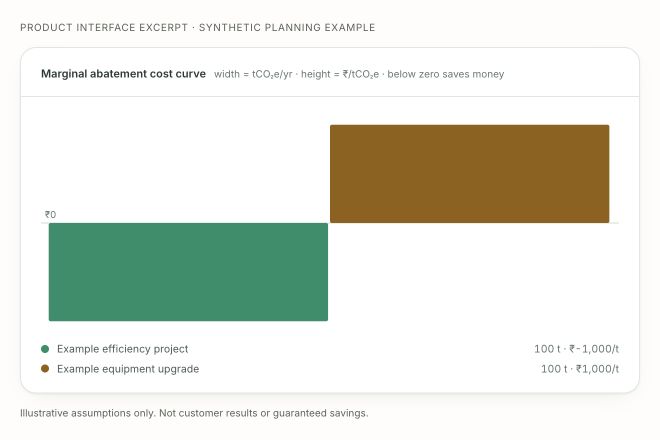
Compare upfront investment, annual operating-cost changes and project lifetime. A cost-per-tonne view provides a consistent starting point for screening.
03 / A practical shortlist
Explore options against the target, available capital and operating constraints. Review AI-assisted proposals before adding them to the plan, then identify the assumptions that need engineering validation.
A different view
of the same decision.
The next review
starts with the evidence.
Bring the shortlist, project assumptions and cost-and-abatement comparison into the management discussion. A scoped engagement identifies the inputs, supported scenarios and review responsibilities.
How to use the comparison
This is undiscounted screening, not investment-grade NPV or IRR. Validate engineering feasibility, project overlap, operating conditions and delivery costs before making an investment decision. Savings and certificate revenues are not guaranteed.
The current CCTS planning workflow uses Indian compliance assumptions and INR-based project economics. Other requirements and currencies need a scope review.